If you’re looking for how to memorize vocabulary fast, you’ve probably tried the obvious already: write a long list, read it a few times, maybe cram it the night before a lesson. It works for a day. By the weekend most of it is gone, and you’re relearning the same words.
The fix isn’t more hours. It’s spending the hours you have on the few things memory research keeps supporting: context, recall, spacing and saying words out loud. The method below works for English or any other language you learn from your own. It won’t promise a number of words per month. It will stop you wasting reviews.
Why do you forget new words so quickly?
Three things work against you when you learn from a list.
- Forgetting is fastest at the start. The forgetting curve that Hermann Ebbinghaus measured in 1885 drops steeply in the first hour and day, then levels off. One exposure, even a long one, sits on the steep part. Our guide to spaced repetition and the forgetting curve explains the curve in detail.
- Rereading feels like learning. Seeing a word again makes it familiar, and familiar feels like known. But recognizing a word on a list is not the same as producing it in a conversation.
- Isolated words have nothing to hold on to. «Weather» on its own is just a sound and a translation. «Under the weather» is a phrase you can picture, use and remember.
Should you learn words in context or on their own?
In context, almost always. A short phrase or sentence tells you what the word means, which words it usually goes with, and how it behaves in grammar. That’s three things you would otherwise have to learn separately.
Some practical rules:
- Learn collocations, not single words. «Make a mistake», «heavy rain», «take a break». Learners who know «mistake» but say «do a mistake» learned the word without its partner.
- Keep the phrase short. One target per card. If the sentence has two new words in it, it’s two cards.
- Use your own sentences when you can. A sentence about your job, your city or your friends is easier to recall than a textbook example, because it’s connected to things you already know.
- Add a note for what the phrase doesn’t show. Register (informal, rude, formal), a false friend, an irregular form.
Why is testing yourself better than rereading word lists?
Because recalling a word strengthens it in a way that looking at it doesn’t. The best-known evidence is a 2008 study in Science by Jeffrey Karpicke and Henry Roediger, The critical importance of retrieval for learning. Students learned 40 Swahili–English word pairs. A week later, those who kept being tested on every pair recalled about 80% of them. Those whose pairs were dropped from testing after one correct answer recalled about a third, even when they kept studying the pairs. The students themselves couldn’t tell the difference: their predictions didn’t match their results.
A 2013 review of common study techniques led by John Dunlosky reached the same conclusion from a wider angle. It rated practice testing and spacing your study as the most useful techniques, and rereading and highlighting among the least useful, as the Association for Psychological Science summary puts it.
In practice:
- Look at one side of the card.
- Say the answer before you look. A wrong guess still counts as practice.
- Flip and check, honestly.
- Practice both directions. Recognizing a foreign word is easier than producing it from your own language, so test the harder direction too.
How many new words should you learn per day?
Fewer than you think, every day, instead of many at once. Spreading the same study time across several days leads to better long-term recall than one long session; that’s one of the most consistent findings in learning research.
There’s no proven ideal batch size. A good one is small enough that you’ll still do it on a bad day and still have time to review older words. Start with something like 10 new cards a day. If your reviews keep up, add more. If they start to pile up, add fewer new words until you catch up. Steady beats heroic.
Does saying words out loud help you remember them?
Yes, and it costs nothing. Psychologists call it the production effect. In a 2010 series of eight experiments, Colin MacLeod and colleagues found that saying a word aloud while studying it improved memory compared with reading it silently. The benefit showed up when some words were spoken and others weren’t, which the authors explain by distinctiveness: the spoken words stand out.
For vocabulary that means:
- Say every answer out loud when you test yourself, especially for the words you keep getting wrong.
- Listen before you speak. Hearing a word read aloud gives you the sound to copy, not just the spelling.
- Speak whole phrases, not single words, so the rhythm of the phrase sticks along with the word.
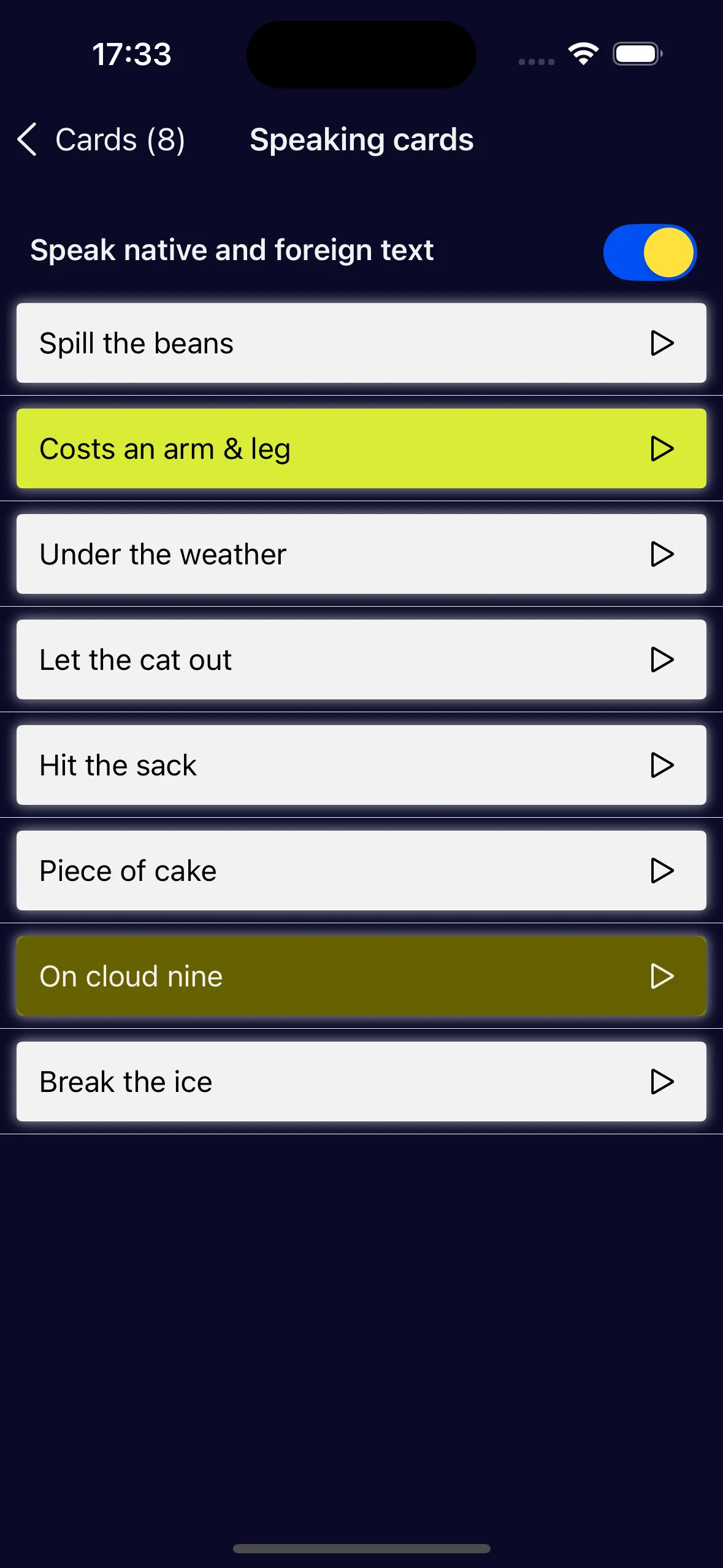
In Just R, speaking cards play a deck aloud using iOS text-to-speech voices. Turn on Speak native and foreign text to hear both sides, and change the voice, rate and pitch in Settings. A Record sentence card lets you make a card by speaking: hold the record button, say the sentence, and Just R writes down what iOS speech recognition heard.
Do pictures and mnemonics help you memorize vocabulary?
They help most with concrete words that don’t stick any other way. In his twenty rules of formulating knowledge, published on the SuperMemo site, Piotr Wozniak recommends using imagery, and suggests mnemonic tricks for the minority of items that are genuinely hard, not for everything.
A few ways to use them without slowing down:
- Picture the phrase, not the word. «Spill the beans» is easier to picture than «secret».
- Make the image personal or a bit absurd. The odder the image, the easier it is to tell apart from similar words.
- Use an image only when a word has failed a few times. For most cards, a good phrase and regular recall are enough.
Just R can also generate an image for a card from a text prompt. It’s optional, it’s sold as a small in-app purchase, and it uses OpenAI: before the first use the app asks your permission, because the text of your card is sent to OpenAI (your name, email and account details are not). Picturing the phrase yourself costs nothing and is a good first step.
How often should you review new vocabulary?
Review new words within minutes, again the same day, then after a day, a few days, about a week, a month and a few months. Each gap should be a bit longer than the last, and each review should be a test.
The hard part isn’t knowing the schedule; it’s remembering to follow it. That’s what reminders are for. Just R can schedule a deck’s reminders on the intervals Ebbinghaus measured, from 1 minute to 3 months, as notifications or Calendar events, or at your own times. The spaced repetition feature shows how.
When can you stop reviewing a word?
When it still comes back easily after a month or more, it has earned a rest. Keep reviewing words you know and you’ll run out of time for new ones.
- Mark finished decks as finished. A long press on a deck in Just R lets you mark it as finished, and you can filter your decks to show only the active ones.
- Rewrite cards you keep failing. A card you’ve forgotten five times is often a badly made card: too many meanings, no context, or too close to another card. Our guide on how to make vocabulary flashcards covers the fixes.
- Use the words. Reading, writing a message or saying a phrase in a real conversation is a review too, and the kind that matters most.
How to memorize vocabulary with Just R, step by step
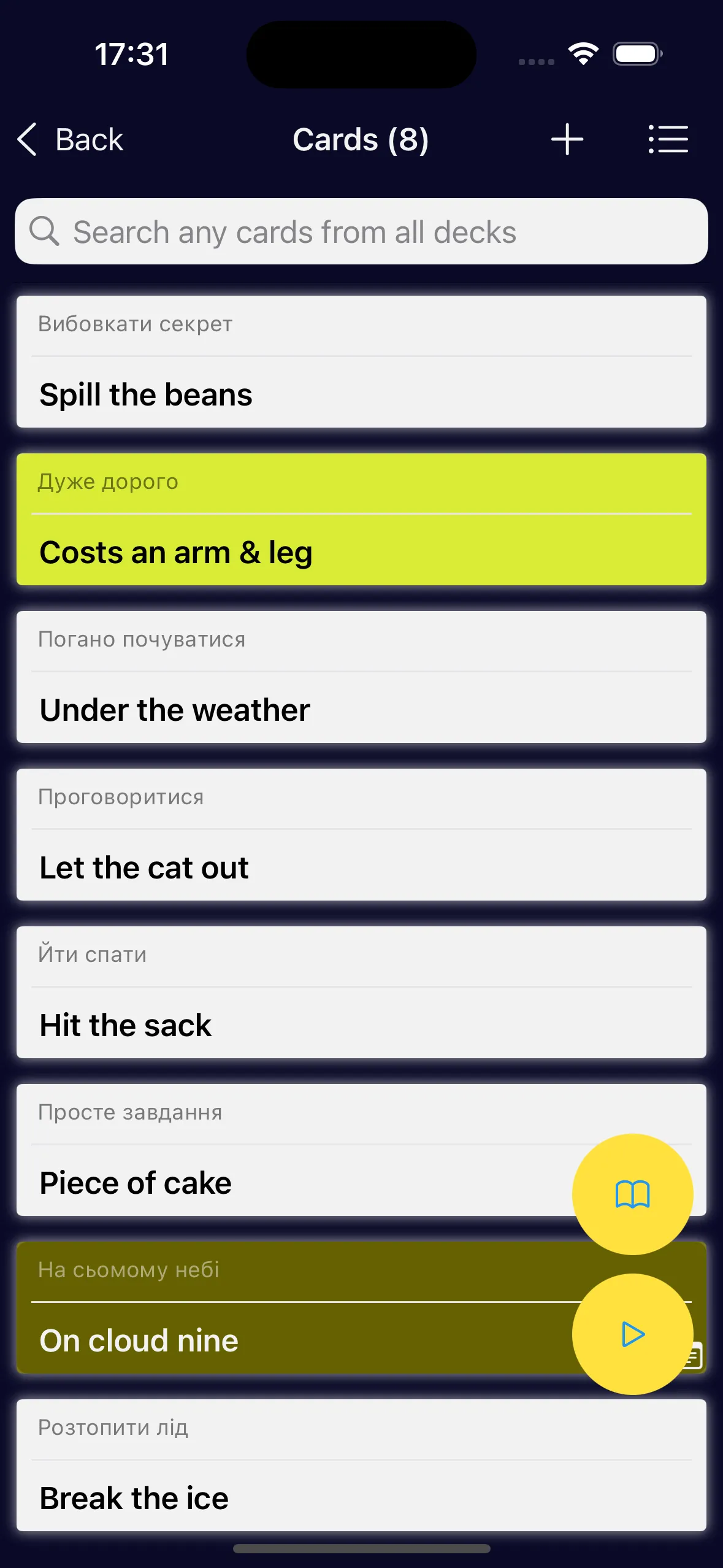
- Make a small deck for this week’s words, grouped by topic or source: one show, one chapter, one lesson.
- Add each word as a phrase. Use a Word to word card for short phrases and a Sentence to sentence card for full sentences, with a note for anything the phrase doesn’t show.
- Study in flip mode. Answer out loud, then flip and swipe the card to Remember or Forgot.
- Listen to the deck with Speaking cards on a walk or before you sleep.
- Set reminders with Ebbinghaus’s forgetting curve, so the next reviews come to you.
- Retire the deck with a long press when it’s solid, and start the next one.
Try it in Just R: take ten words you met this week, add each one as a short phrase with its translation, and run the deck in flip mode while saying every answer out loud. Then open the deck’s menu, choose Set reminder and turn on «Use Ebbinghaus’s forgetting curve».
What this method can’t promise
- No promised speed. How fast words stick depends on the language, how similar it is to yours, how often you meet the words and how much time you have. Anyone promising a fixed number of words in a fixed number of days is guessing.
- Vocabulary isn’t fluency. Flashcards build the word store. Listening, reading and speaking turn it into something you can use.
- An app can’t do the recall for you. Reminders, audio and images help, but the work is answering from memory, every time.
Questions about decks, sync or Premium? The FAQ has the short answers.
Frequently asked questions
What is the fastest way to memorize English words?
Learn them in short phrases, test yourself from memory instead of rereading, and review on spaced intervals. It isn't a shortcut, but it wastes the least time, because each review lands when a word is starting to fade.
How many new words should I learn a day?
There is no proven number. Pick a batch you can review comfortably every day, such as 10 new cards, and keep it steady. If reviews start piling up, add fewer new words until you catch up.
Is it better to learn words alone or in sentences?
In a short phrase or sentence, in most cases. Context shows how the word is used and gives your memory something meaningful to connect it to. Keep the sentence short so the card still tests one thing.
Do pictures and mnemonics help you memorize vocabulary?
They can help with words that refuse to stick, especially concrete nouns. Save them for the hard cases rather than every card, because a good image or memory trick takes time to make.
Can Just R read my words aloud?
Yes. Speaking cards play a deck aloud with iOS text-to-speech voices, the native and the foreign text if you want both, and you can change the voice, rate and pitch in Settings.