Spaced repetition is a simple idea: review something just as you’re starting to forget it, then wait longer before the next review. It rests on one of the oldest results in psychology, the Ebbinghaus forgetting curve, and on more than a century of research on spacing and testing since. If you’ve ever crammed fifty words on Sunday and lost most of them by Wednesday, the curve explains why, and spaced repetition is the fix.
This guide covers what Ebbinghaus actually measured (and what he didn’t), why spacing beats cramming, why every review should be a quiz rather than a reread, and how to choose review intervals. The last part shows how Just R turns the curve into reminders for each deck.
What is the Ebbinghaus forgetting curve?
The forgetting curve is a graph of how much of something you’ve learned is still in memory as time passes. It drops steeply at first and then flattens out: you lose a lot within the first hour, less over the next day, and much less over the weeks after that.
How did Ebbinghaus measure forgetting?
Hermann Ebbinghaus, a German psychologist, ran his memory experiments with a single subject: himself. He published them in 1885; the English translation from 1913 is called Memory: A Contribution to Experimental Psychology.
He wanted material without any meaning attached, so he used nonsense syllables, learned in series of 13. He learned a series until he could recite it without a mistake, waited, and then learned it again. His measure was savings: how much less work the relearning took compared with the first time. The less work it took, the more he had kept.
He relearned the series after about a third of an hour, 1 hour, 9 hours, 1 day, 2 days, 6 days and 31 days. In chapter 7 of Memory he summarizes the results roughly like this:
- After 1 hour, about half of the original work had to be done again.
- After 1 day, about a third of the original work was still saved.
- After 6 days, about a quarter.
- After a month, about a fifth.
Two things are worth keeping in mind before you apply this to your own vocabulary.
- It was one person learning meaningless syllables. Words you actually need come with meaning, sound and situations attached. Your own curve won’t match these numbers. What carries over is the shape: steep loss early, slower loss later.
- Savings is not «percent of words you remember». It measures how much faster relearning goes. Even when you can’t recall a word, relearning it usually takes less work than learning it the first time.
Has the forgetting curve been replicated?
Yes. In 2015 Jaap Murre and Joeri Dros published a replication of Ebbinghaus’s forgetting curve in PLOS ONE. Dros, the second author, was the single subject, as Ebbinghaus had been. He spent about 70 hours over roughly 75 days learning lists of nonsense syllables at the same seven intervals, scored with the same savings method. The authors concluded that the curve had indeed been replicated.
They added one detail: the curve is probably not perfectly smooth. Savings seemed to jump up at the 24-hour point, which they link to research on sleep and memory, while noting that this explanation still needs to be tested directly.
So the forgetting curve is a well-replicated finding about how memory fades when you don’t review. It isn’t a formula that predicts how many of your words you’ll still know on day six.
Why does spaced repetition beat cramming?
Cramming, or massed practice, means many repetitions in one sitting. Spacing, or distributed practice, means the same repetitions spread over time. For long-term recall, spacing wins, and this is one of the most studied effects in learning research.
The largest review of it is a 2006 meta-analysis in Psychological Bulletin by Nicholas Cepeda and colleagues, Distributed practice in verbal recall tasks. It pulled together 839 assessments of distributed practice from 317 experiments in 184 articles. The authors note that the benefit was being reported as early as the late 1800s, Ebbinghaus included. Their main practical finding: the gap between study sessions and the time until you need the material work together, and the gap that gives the best retention gets longer as the retention interval gets longer.
In plain terms: if you need words for a quiz in a few days, short gaps are enough. If you want them in six months, the gaps have to stretch to weeks and then months. Cramming can get you through tomorrow; it just sits on the steepest part of the curve, so it fades fast.
Why should every review be a test, not a reread?
Spacing tells you when to review. Retrieval practice tells you how. Looking at a word and its translation again feels productive, but pulling the answer out of your own memory does much more.
The classic demonstration is a 2008 study in Science by Jeffrey Karpicke and Henry Roediger, The critical importance of retrieval for learning. Students learned 40 Swahili–English word pairs, the same shape as a vocabulary flashcard. Once a pair was recalled correctly, depending on the group, it was dropped from further study, from further testing, or from both. On the final test a week later:
- Students who kept being tested on every pair recalled about 80% of them.
- Students whose recalled pairs were dropped from testing recalled about 36% and 33%, even though one of those groups kept studying every pair.
- Extra studying after the first correct recall made no measurable difference. Extra testing did.
- Every group predicted it would recall about half of the pairs. Their predictions didn’t track how they actually did.
That last point matters most: rereading and testing feel alike from the inside, and they aren’t. For flashcards it means one thing. Look at the prompt, answer from memory (out loud is even better), and only then flip.
How do you choose spaced repetition intervals?
No set of intervals is proven best for everyone. The research supports a handful of rules, and they’re enough to build a schedule:
- Review soon after you first learn. The curve is steepest in the first hour, so a check within minutes and another the same day catch what’s slipping.
- Stretch each gap. After the same-day reviews, move to a day, then a few days, about a week, a month and a few months.
- Match the gaps to your goal. An exam next week needs a compressed schedule. A language you want to keep for years needs gaps that keep growing.
- Shorten the gap when you forget. If most of a deck failed on day six, run it again in a day or two instead of waiting a month.
- Make every review a recall. Prompt first, answer from memory, then check.
- Retire what you know. When a deck still comes back easily after a month or more, stop reviewing it and spend the time on new words.
How to use spaced repetition with flashcards
Put those rules together and a schedule for one deck looks like this. It’s the default set Just R uses:
| Review |
Time after learning |
Why it’s there |
| 1 |
1 minute |
Check that the cards went in at all |
| 2 |
20 minutes |
Ebbinghaus’s first measuring point, on the steep part of the curve |
| 3 |
1 hour |
In his data, about half the work had to be redone by now |
| 4 |
9 hours |
Usually the same evening |
| 5 |
1 day |
After a night’s sleep |
| 6 |
2 days |
The gaps start to stretch |
| 7 |
6 days |
About a week |
| 8 |
1 month |
Close to Ebbinghaus’s last point (31 days) |
| 9 |
3 months |
A long-term check beyond his range |
Ebbinghaus didn’t prescribe these as a study plan. They were the points where he measured forgetting. They make a sensible review schedule because they’re dense early and sparse later, which is the shape of the curve itself.
Fixed schedule or adaptive algorithm?
Some flashcard apps calculate a new date for every card based on your answers. Just R works at the deck level: one schedule per deck, from Ebbinghaus’s intervals or your own times. It’s easy to follow, and you decide when a deck needs an extra round. The trade-off: hard and easy cards in a deck come back together, so keep decks small.
How does Just R schedule spaced repetition reminders?
Each deck in Just R can have its own reminder schedule.
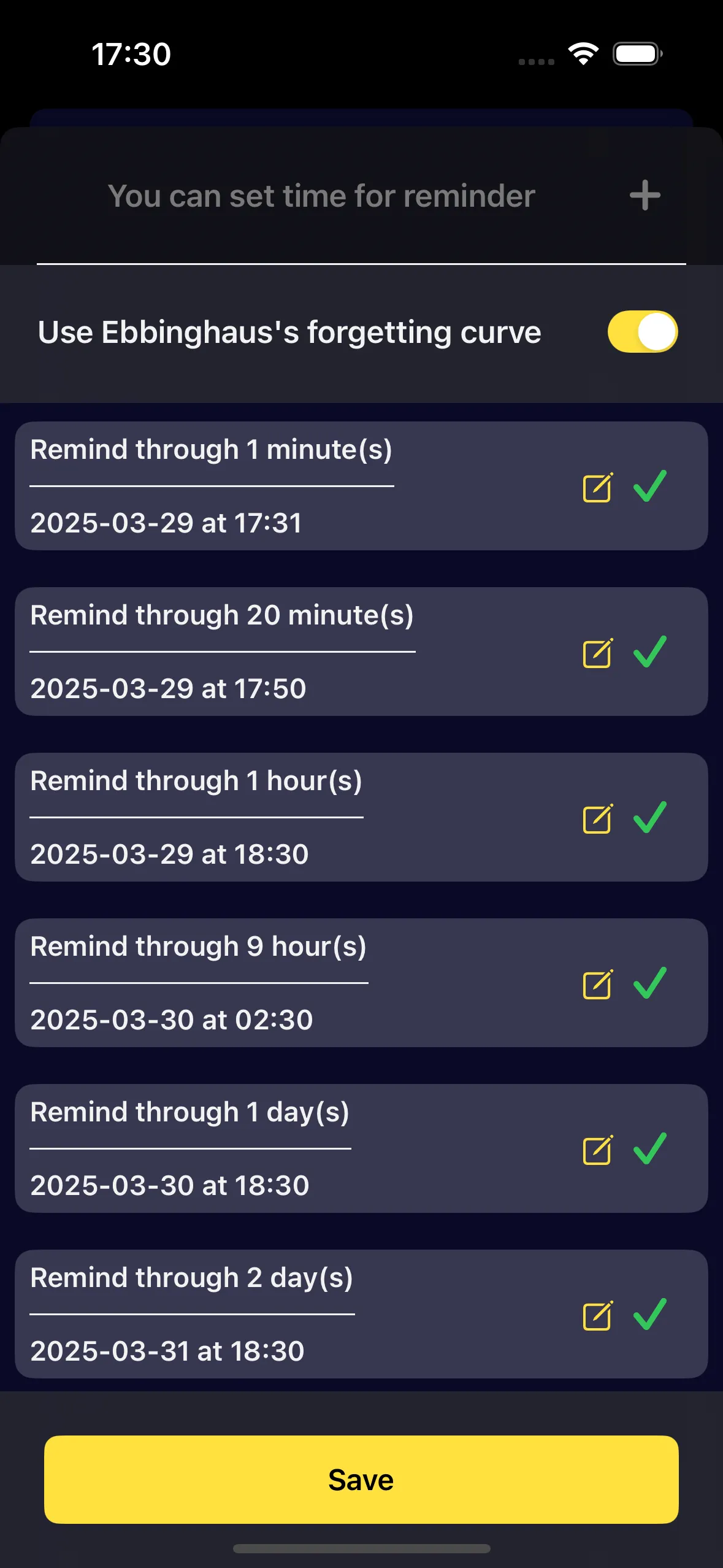
- Open a deck, tap the menu button at the top right of the card list, and choose Set reminder.
- Turn on Use Ebbinghaus’s forgetting curve. Just R fills in reminders after 1 minute, 20 minutes, 1 hour, 9 hours, 1 day, 2 days, 6 days, 1 month and 3 months, each with its exact date and time.
- Untick any reminder you don’t want, or tap the edit icon to move it. To build your own schedule instead, tap + and add the times yourself.
- Tap Save and choose how reminders arrive: as a Local notification on your iPhone or iPad, or as a Calendar event. Calendar needs access to your calendar, and Just R asks for it the first time.
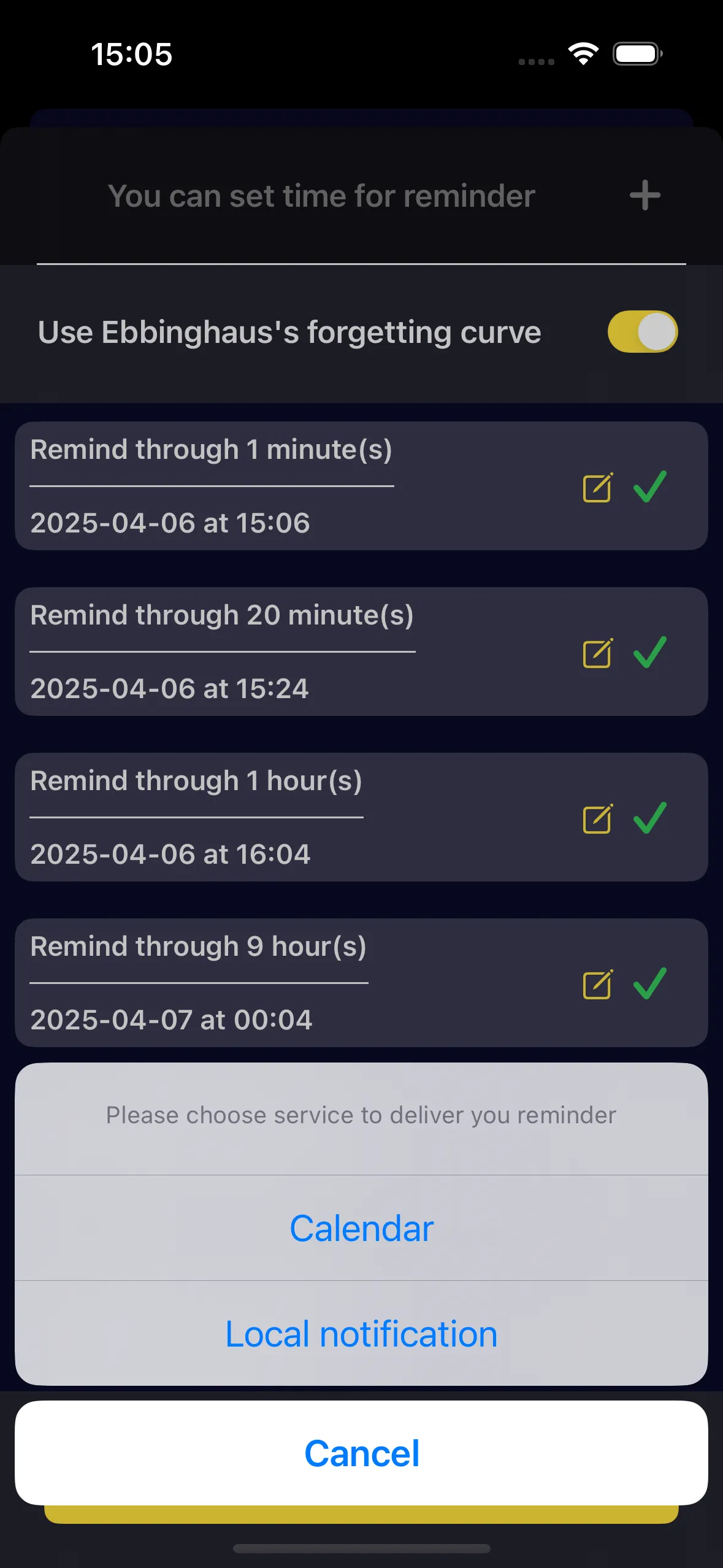
The times count from when you set up the schedule, so do it right after your first session with a new deck.
When a reminder arrives, open the deck in flip mode and swipe each card to Remember or Forgot after you’ve answered it in your head. When you finish a pass, Just R records the repetition. It counts repetitions per day and in total, and a long press on a deck shows every date it was repeated and lets you mark it as finished.
Try it in Just R: pick a deck you learned today, open its menu, choose Set reminder and turn on «Use Ebbinghaus’s forgetting curve». Save the reminders as Calendar events if you live in your calendar, or as notifications if you don’t. When each one arrives, answer every card from memory before you flip it.
What can’t spaced repetition do?
Being clear about the limits helps you use it well:
- It can’t fix a bad card. A card with five meanings, or a word with no context, is hard to recall at any interval. Our guide on how to make vocabulary flashcards covers what to put on each card.
- It keeps what you’ve understood; it doesn’t explain it. Learn the meaning first, then schedule the reviews.
- A reminder is a prompt, not a review. It only helps if you open the deck when it arrives.
- The numbers are one person’s syllables. Treat the curve as a guide to timing, not a forecast of your memory.
For the rest of the method, such as learning words in phrases, saying them aloud and keeping daily batches small, read how to memorize vocabulary fast. The spaced repetition section of the features page shows the reminder options in one place, and the FAQ answers questions about sync, Premium and privacy.
Frequently asked questions
What is the Ebbinghaus forgetting curve?
It is a graph of how much of what you learned is still in memory as time passes. Hermann Ebbinghaus measured it on himself in 1885 by relearning lists of nonsense syllables: memory dropped quickly in the first hour and then much more slowly over days and weeks.
What are the best spaced repetition intervals?
There is no single best set. A common pattern is a review within minutes, another later the same day, then after 1 day, a few days, about a week, a month and a few months. Research suggests the right gap depends on how long you need to remember, so stretch the gaps when recall is easy and shorten them when you forget.
Is spaced repetition better than cramming?
For remembering things over weeks and months, yes. Cramming can get you through a test tomorrow, but the same study time spread across several sessions leads to better long-term recall in a large body of research.
Does Just R change the schedule for each card based on my answers?
No. Just R schedules reminders per deck, either on Ebbinghaus's intervals or at times you set. Swiping a card to Remember or Forgot is a check for you; it does not move that card to a different date.
How do I turn on forgetting curve reminders in Just R?
Open a deck, tap the menu at the top right of the card list and choose Set reminder. Turn on «Use Ebbinghaus's forgetting curve», tap Save, and choose whether reminders arrive as local notifications or Calendar events.